
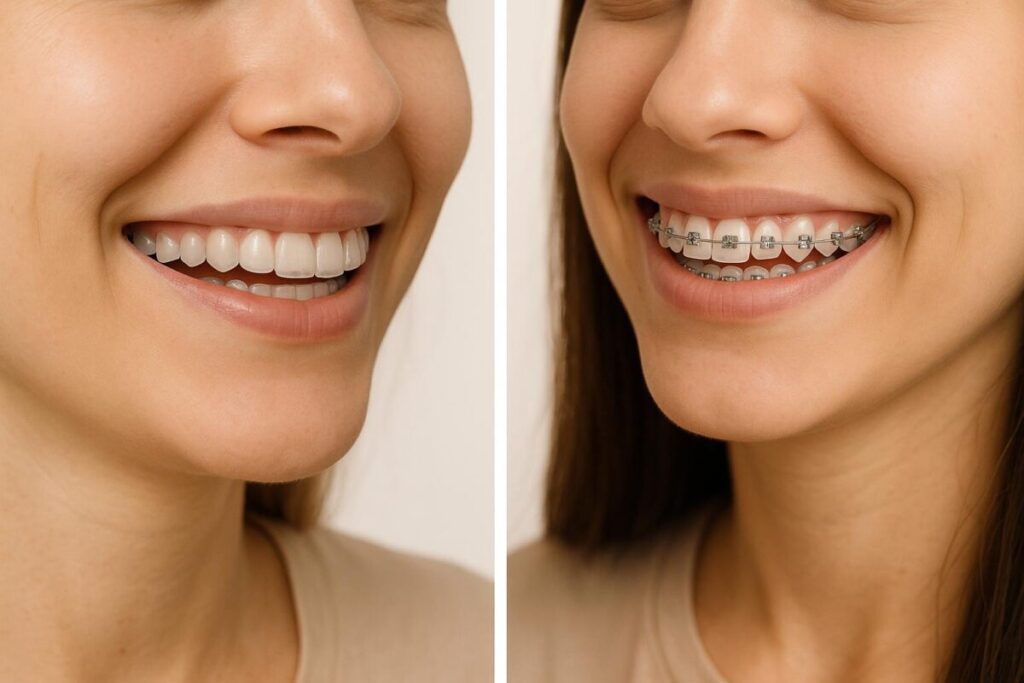
Choosing the right orthodontic treatment is a crucial step toward achieving a confident, healthy smile. Today, patients have access to discreet alternatives beyond traditional braces, with Lingual Braces and Invisible Aligners emerging as two of the most popular options. Both treatments are designed to straighten teeth effectively while maintaining a natural appearance but they differ significantly in approach, comfort, and suitability.
If you’re wondering “Lingual Braces vs Invisible Aligners: which is better for your smile?”, this detailed guide will help you make an informed decision.
Understanding Lingual Braces
Lingual Braces are fixed orthodontic appliances that are attached to the inner (lingual) surface of your teeth. This placement makes them completely hidden from the outside, offering a truly invisible solution for teeth straightening.
Advantages of Lingual Braces
- Completely invisible from the front
- Ideal for moderate to complex orthodontic cases
- Custom-made for precise tooth movement
- No need to remember wearing them
Limitations of Lingual Braces
- Initial discomfort or tongue irritation
- May temporarily affect speech
- Cleaning requires extra care
- Usually higher in cost due to customization
Despite these considerations, Lingual Braces remain a top choice for patients who want a fixed, highly effective, and discreet orthodontic treatment.
Understanding Invisible Aligners
Invisible Aligners, often referred to as clear aligners, are removable plastic trays that gradually move your teeth into alignment. Brands like Invisalign have made this option widely popular, especially among working professionals and adults.
Advantages of Invisible Aligners
- Nearly invisible appearance
- Removable for eating, brushing, and flossing
- More comfortable with no wires or brackets
- Fewer dental visits required
Limitations of Invisible Aligners
- Must be worn for 20–22 hours daily
- Not suitable for severe orthodontic problems
- Easily misplaced or forgotten
- Results depend on patient discipline
Invisible Aligners are ideal for those who value flexibility and comfort while undergoing orthodontic treatment.
Lingual Braces vs Invisible Aligners: A Detailed Comparison
1. Aesthetic Appeal
Both treatments are designed to be discreet:
- Lingual Braces are completely hidden behind the teeth
- Invisible Aligners are transparent but still slightly noticeable
Verdict: Lingual Braces offer total invisibility.
2. Comfort Level
- Invisible Aligners are smooth and comfortable
- Lingual Braces may cause irritation initially
Verdict: Invisible Aligners are more comfortable.
3. Effectiveness
- Lingual Braces handle complex alignment and bite issues effectively
- Invisible Aligners are best for mild to moderate cases
Verdict: Lingual Braces are more versatile for complex treatments.
4. Convenience and Lifestyle
- Invisible Aligners can be removed anytime
- Lingual Braces are fixed and always working
Verdict: Invisible Aligners offer more flexibility.
5. Maintenance and Oral Hygiene
- Aligners are easy to clean and maintain
- Lingual braces require careful brushing and flossing
Verdict: Invisible Aligners are easier to maintain.
6. Cost Consideration
The cost of Lingual Braces vs Invisible Aligners depends on individual cases:
- Lingual Braces are often more expensive
- Invisible Aligners may be more budget-friendly
Verdict: Invisible Aligners are generally more affordable.
Which Treatment Is Right for You?
Choose Lingual Braces If:
- You want a completely invisible solution
- You have complex dental issues
- You prefer a fixed, non-removable treatment
Choose Invisible Aligners If:
- You want comfort and convenience
- Your case is mild to moderate
- You can commit to wearing aligners regularly
Lingual Braces & Invisible Aligners in Modern Orthodontics
Advancements in orthodontics have made both Lingual Braces and Invisible Aligners highly effective and accessible. Many clinics now use digital scanning and 3D imaging to design customized treatment plans, improving accuracy and reducing treatment time.
Patients today also benefit from personalized smile design, allowing them to preview results before starting treatment. Whether you choose Lingual Braces or Invisible Aligners, both options provide excellent outcomes when guided by an experienced orthodontist.
Key Factors to Consider Before Choosing
Before making a decision, consider the following:
- Severity of your dental issue
- Your daily lifestyle and discipline level
- Budget and treatment duration
- Comfort preferences
- Professional advice from an orthodontist
A proper consultation ensures you choose the most effective treatment tailored to your needs.
Conclusion
When comparing Lingual Braces vs Invisible Aligners, there is no universal “best” option. Each treatment has its strengths:
- Lingual Braces are ideal for complete invisibility and complex cases
- Invisible Aligners are perfect for comfort, flexibility, and convenience
Ultimately, the best choice depends on your specific dental condition and lifestyle preferences. Consulting a qualified orthodontist will help you determine the most suitable option for achieving your dream smile.
FAQs
1. Are Lingual Braces better than Invisible Aligners?
Lingual Braces are better for complex cases, while Invisible Aligners are ideal for mild to moderate alignment.
2. Do Invisible Aligners work faster than Lingual Braces?
In some mild cases, aligners may work faster, but treatment time depends on individual conditions.
3. Are Lingual Braces painful?
They may cause initial discomfort, but patients adjust over time.
4. Can adults use both treatments?
Yes, both Lingual Braces and Invisible Aligners are suitable for adults.